
Tuesday, November 28, 2017


Thursday, October 26, 2017

Sunday, April 09, 2017
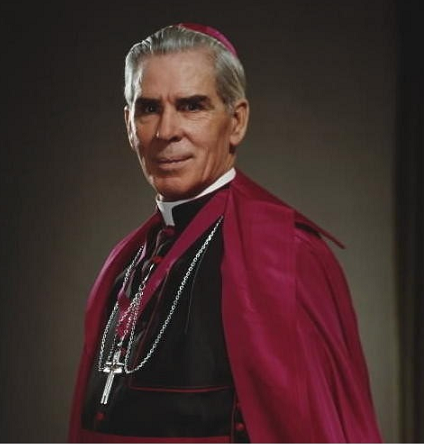
A Plea for Intolerance
Venerable Fulton J. Sheen
America, it is said, is suffering from intolerance. It is not. It
is suffering from tolerance: tolerance of right and wrong, truth and error,
virtue and evil, Christ and chaos. Our country is not nearly so much overrun
with the bigoted as it is overrun with the broadminded. The man who can make up
his mind in an orderly way, as a man might make up his bed, is called a bigot;
but a man who cannot make up his mind, any more than he can make up for lost
time, is called tolerant and broadminded. A bigoted man is one who refuses to
accept a reason for anything; a broadminded man is one who will accept anything
for a reason—providing it is not a good reason. It is true that there is a
demand for precision, exactness, and definiteness, but it is only for precision
in scientific measurement, not in logic. The breakdown that has produced this
unnatural broadmindedness is mental, not moral. The evidence for this statement
is threefold: the tendency to settle issues not by arguments but by words, the
unqualified willingness to accept the authority of anyone on the subject of
religion, and, lastly, the love of novelty.
Voltaire boasted that if he could find but ten wicked words a day he could crush the “infamy” of Christianity. He found the ten words daily, and even a daily dozen, but he never found an argument, and so the words went the way of all words and the thing, Christianity, survived. Today, no one advances even a poor argument to prove that there is no God, but they are legion who think they have sealed up the heavens when they used the word “anthropomorphism.” This word is just a sample of the catalogue of names which serve as the excuse for those who are too lazy to think. One moment’s reflection would tell them that one can no more get rid of God by calling Him “anthropomorphic” than he can get rid of a sore throat by calling it “streptococci.” As regards the use of the term “anthropomorphism,” I cannot see that its use in theology is less justified than the use in physics of the term “organism,” which the new physicists are so fond of employing. Certain words like “reactionary” or “medieval” are tagged on the Catholic Church and used with that same disrespect with which a man may sneer at a woman’s age. Mothers do not cease to be mothers because their sons grow up, and the Mother Church of the Christian world, which began not in Boston but in Jerusalem, is not to be dispossessed of her glorious title simply because her sons leave home. Some day they may be glad to return and their return will be the truest “homecoming” the world has ever seen.
In that statement is the final argument for modern broad‐mindedness:
truth is novelty, and hence ʺtruthʺ changes with the
passing fancies of the moment. Like the chameleon who changes his colors to
suit the vesture on which he is placed, so truth is supposed to change to suit
the foibles and obliquities of the age, as if the foundations of thinking might
be true for the pre‐Adamites and false for the Adamites. Truth does grow, but
it grows homogeneously, like an acorn into an oak; it does not swing in the
breeze, like a weathercock. The leopard does not change his spots nor the Ethiopian
his skin, though the leopard be put in bars or the Ethiopian in pink tights.
The nature of certain things is fixed, and none more so than the nature of
truth. Truth maybe contradicted a thousand times, but that only proves that it
is strong enough to survive a thousand assaults. But for any one to say, ʺSome say this, some say that, therefore there
is no truth,ʺ is about as logical
as it would have been for Columbus, who heard some say, ʺThe earth is round,ʺ and other say, ʺThe earth is flat,ʺ to conclude: ʺTherefore there is no earth at all.ʺ
It is this kind of thinking that cannot distinguish between a sheep and his second coat of wool, between Napoleon and his three‐cornered hat, between the substance and the accident, the kind that has begotten minds so flattened with broadness that they have lost all their depth. Like a carpenter who might throw away his rule and use each beam as a measuring‐rod, so, too, those who have thrown away the standard of objective truth have nothing left with which to measure but the mental fashion of the moment.
In the face of this false broad‐mindedness, what the world needs is intolerance. The mass of people have kept up hard and fast distinctions between dollars and cents, battleships and cruisers, ʺYou owe meʺ and ʺI owe you,ʺ but they seem to have lost entirely the faculty of distinguishing between the good and the bad, the right and the wrong. The best indication of this is the frequent misuse of the terms ʺtoleranceʺ and ʺintolerance.ʺ There are some minds that believe that intolerance is always wrong, because they make ʺintoleranceʺ mean hate, narrow mindedness, and bigotry. These same minds believe that tolerance is always right because, for them, it means charity, broad‐mindedness, American good nature.
What is tolerance? Tolerance is an attitude of reasoned patience towards evil, and a forbearance that restrains us from showing anger or inflicting punishment. But what is more important than the definition is the field of its application. The important point here is this: Tolerance applies only to persons, but never to truth. Intolerance applies only to truth, but never to persons. Tolerance applies to the erring; intolerance to the error.
Thus far tolerance, but no farther. Tolerance does not apply to truth or principles. About these things we must be intolerant, and for this kind of intolerance, so much needed to rouse us from sentimental gush, I make a plea. Intolerance of this kind is the foundation of all stability. The government must be intolerant about malicious propaganda, and during the World War it made an index of forbidden books to defend national stability, as the Church, who is in constant warfare with error, made her index of forbidden books to defend the permanency of Christʹs life in the souls of men. The government during the war was intolerant about the national heretics who refused to accept her principles concerning the necessity of democratic institutions, and took physical means to enforce such principles. The soldiers who went to war were intolerant about the principles they were fighting for, in the same way that a gardener must be intolerant about the weeds that grow in his garden. The Supreme Court of the United States is intolerant about any private interpretation of the first principle of the Constitution that every man is entitled to life, liberty, and the pursuit of happiness, and the particular citizen who would interpret ʺlibertyʺ in even such a small way as meaning the privilege to ʺgoʺ on a red traffic‐light, would find himself very soon in a cell where there were no lights, not even the yellow — the color of the timid souls who know not whether to stop or go. Architects are as intolerant about sand as foundations for skyscrapers as doctors are intolerant about germs in their laboratories, and as all of us are intolerant of a particularly broad‐minded, ʺtolerant,ʺ and good‐natured grocer who, in making our bills, adds seven and ten to make twenty.
Now, if it is right — and it is right — for governments to be intolerant about the principles of government, and the bridge builder to be intolerant about the laws of stress and strain, and the physicist to be intolerant about the principles of gravitation, why should it not be the right of Christ, the right of His Church, and the right of thinking men to be intolerant about the truths of Christ, the doctrines of the Church, and the principles of reason? Can the truths of God be less exacting than the truths of mathematics? Can the laws of the mind be less binding than the laws of science, which are known only through the laws of the mind? Shall man, gifted with natural truth, who refuses to look with an equally tolerant eye on the mathematician who says two and two make five and the one who says two and two make four, be called a wise man, and shall God, Who refuses to look with an equally tolerant eye on all religions, be denied the name of ʺWisdom,ʺ and be called an ʺintolerantʺ God?
Why, then, sneer at dogmas as intolerant? On all sides we hear it said today, ʺThe modern world wants a religion without dogmas,ʺ which betrays how little thinking goes with that label, for he who says he wants a religion without dogmas is stating a dogma, and a dogma that is harder to justify than many dogmas of faith. A dogma is a true thought, and a religion without dogmas is a religion without thought, or a back without a backbone. All sciences have dogmas. ʺWashington is the capital of the United Statesʺ is a dogma of geography. ʺWater is composed of two atoms of hydrogen and one of oxygenʺ is a dogma of chemistry. Should we be broad‐minded and say that Washington is a sea in Switzerland? Should we be broad‐minded and say that H2O is a symbol for sulfuric acid?
So also, my reason sifts the historical evidence for Christ; it weighs the testimony adduced by those who knew Him, and the testimony given by Himself. It fails to be swayed by those who start with a preconceived theory, rejecting all the evidence against their theory and accepting the residue as the Gospels. In the search, it comes across such works as those of Renan and Strauss, which are critical, but it also comes across such works as those of Fillion and Grandmaison: it knows the name of Loisy, but it also knows Lagrange; it knows the theory of Inge, but it also knows DʹHerbigny. And this reason finally leads me to accept the testimony of Jesus Christ as the testimony of God. I then accept these truths — truths which I cannot prove, as was Professor Eddingtonʹs statement about Einstein — and these truths become dogmas.
There can thus be dogmas of religion as well as dogmas of science, and both of them can be revealed, the one by God, the other by man. Not only that — these fundamental dogmas, like the first principles [elements] of Euclid, can be used as raw material for thinking, and just as one scientific fact can be used as the basis of another, so one dogma can be used as the basis for another. But in order to begin thinking on a first dogma, one must be identified with it either in time or in principle. The Church was identified with Christ in both time and principle; she began thinking on His first principles and the harder she thought, the more dogmas she developed. Being organic like life, not institutional like a club, she never forgot those dogmas; she remembered them and her memory is tradition. Just as a scientist must depend on the memory of the first principles of his science, which he uses as the ground for other conclusions, so too the Church goes back into her intellectual memory, which is tradition, and uses former dogmas as the foundation for new ones. In this whole process she never forgets her first principles. If she did she would be like the undogmatic dogmatists of the present day, who believe that progress consists in denying the fact, instead of building on it; who turn to new ideals because they have never tried the old; who condemn as ʺobscurantistʺ the truth that has a parentage, and glorify as ʺprogressiveʺ a shibboleth that knows not either its father or its mother. They are of the school that would deny the very nature of things: free the camel of his hump and call him a camel; shorten the neck of a giraffe and call him a giraffe; and never frame a picture, because a frame is a limitation and therefore a principal and a dogma.
But it is anything but progress to act like mice and eat the foundations of the very roof over our heads. Intolerance about principles is the foundation of growth, and the mathematician who would deride a square for always having four sides, and in the name of progress would encourage it to throw away even only one of its sides, would soon discover that he had lost all his squares. So too with the dogmas of the Church, of science, and of reason; they are like bricks, solid things with which a man can build, not like straw, which is ʺreligious experience,ʺ fit only for burning.
A dogma, then, is the necessary consequence of the intolerance of first principles, and that science or that church which has the greatest amount of dogmas is the science or the church that has been doing the most thinking. The Catholic Church, the schoolmaster for twenty centuries, has been doing a tremendous amount of solid, hard thinking and hence has built up dogmas as a man might build a house of brick but grounded on a rock. She has seen the centuries with their passing enthusiasms and momentary loyalties pass before her, making the same mistakes, cultivating the same poses, falling into the same mental snares, so that she has become very patient and kind to the erring pupils, but very intolerant and severe concerning the false. She has been and she will always be intolerant so far as the rights of God are concerned, for heresy, error, untruth, affect not personal matters on which she may yield, but a Divine Right in which there is no yielding. Meek she is to the erring, but violent to the error. The truth is divine; the heretic is human. Due reparation made, she will admit the heretic back into the treasury of her souls, but never the heresy into the treasury of her wisdom. Right is right if nobody is right, and wrong is wrong if everybody is wrong. And in this day and age we need, as Mr. Chesterton tells us, ʺnot a Church that is right when the world is right, but a Church that is right when the world is wrong.ʺ
Friday, April 15, 2016

Tuesday, February 19, 2013
WHY THE DECLINE OF
PATRIOTISM?
by Fulton J. Sheen
There are two reasons, the first reason I believe is that we
live in an age of anti-hero’s. Today the
spirit of America is “I’ve got to me” and so if anyone else is above us with
the the spirit of sacrifice and dedication, we try to drop them to our
level. He’s a reproach to us that
Patriot and hero. He is one of the
reasons I think why the lives that are written about our great Patriots today
are almost like gossips. Look at the
recent lives of Washington that shows how much money he spent, Jefferson, that
he consorted with a Black woman. Abraham
Lincoln is called a racist, imagine, and now the attacks on Kennedy. As soon as we find a great man we ask, wonder
why he acts that way. We impugn his
motives. So it’s difficult to have a hero and Patriot.
Another reason is, we have been humiliated and we take it
out on our country. We have been brought
up on the great American dream; we have more televisions and electric shavers,
radios, automobiles, gadgets than any other country in the world. We believed in definite progress that gets
better and better, nothing could stop us.
Then the Arabs shut off the oil and we begin to find dishonesty in high
places and low places and we took it out on our country. We began to demean it, and the result is
there is a great decline in Patriotism.
What is it that makes a Patriot? Well I will tell you one
thing that doesn’t make a Patriot, when you have a country that is concerned with
the values of people being on a horizontal line. If people believe that the only important
thing is making money or body sense/body pleasures or the love of power, if you
believe that you will never have Patriotism.
They are living for themselves.
What is required of Patriotism? You have to have a value over and above the
horizontal and earthly. You have to have
a realm up here where there is life, the love of honesty, loyalty, justice,
sense of responsibility and God, the source of values. Only when men look to something transcendent do
they have Patriotism. Then when they go
up to this higher realm to draw on the divine then they can come down here and
then their ready to dedicate themselves and sacrifice themselves.
George Washing in 1774 was presiding over the Burgess of
Virginia and word came down to him about an invasion of the civil rights in the
Commonwealth of Massachusetts and he
said we have been disturbed by what has happened in the Commonwealth of Massachusetts. So he
said that in order that we may be strong enough to defend these rights I’m
going to ask that on the first day of June there be a day of fasting, prayer
and reparation. He appealed to the
divine to receive courage to defend the Commonwealth of Massachusetts. Incidentally George Washington wrote, and you
can look it up, in his diary on June 1st that he went to church and
fasted all day. That was Washington
appealing to the transcendent and therefore a Patriot. Do you know that for seven years he was
unable to visit his own Mount Vernon? So
dedicated to his country he did not see his Grandchildren until after the
battle of Yorktown and after he saw them he had to take the duties of being our
President.
Benjamin Franklin at the Convention of Philadelphia said “we
have been voting on the Constitution and we have as many I’s and Nay’s. I think we’re learning the weakness of human
nature and I think it is of great value now that we realize that when we were
at battle with Great Britain we invoked the Divine and now we have almost
forgotten the Divine aid. I suggest that
every day we pray to the Father of Lights and that two Ministers of God be
invited to offer prayer at the beginning of this Convention”. He appealed to the Transcendent, to the
Divine.
Abraham Lincoln is the only President of the United States
that ever gave us a philosophy of history.
In one of the most beautiful documents in our American life Abraham
Lincoln said “we must remember that nations as well as individuals are subject
to God’s judgment and that only nations that invoke God are ever blessed. We have been blessed in this country as no
other nation has ever been blessed, and yet we have forgotten God and may it
not be that the awful calamity of civil war which now devastates our land be
but a just punishment from God for our willful pride. We have believed that all of our successes
have been due to some virtue and powers of our own. It behooves us then to humble ourselves
before the Diving Majesty and to ask for forgiveness”.
This is the way Patriots are made, their made because they
have values above the earthly and human.
Sunday, December 23, 2012
Friday, December 14, 2012
Culture...
Perhaps it started when Cain slew his brother Abel and it
continued with the thousands of wars man has waged ever since. In today’s world the weapons of death have
increased so much so that now evil people fire missiles to kill dozens of innocent
people hundreds of miles away. The hate in man’s heart has only increased. And
why not? Violence, cynicism and moral
irrelevance are so prevalent in TV, movies, music, media, speech, newspapers, books, social media venues and even video games that the acceptance of immoral actions is now the norm. If one concentrates solely on the gun as the
only problem he is missing the real issue.
The evil in man’s heart has been perpetuated, accepted and even
glorified in our culture so much so that to some the right to life means
nothing. When you kill millions of children in the womb and call it choice, kill people in the streets through more violence,
euthanize the elderly and glorify death in movies and TV, you start to foster a
culture that has no respect for its people.
If you were to take away every single gun in America, the evil in men’s
heart would still find a way to hurt and kill someone else because our country is
quickly becoming a culture of death and not a culture of life.... if we’re not
there already.
Thursday, September 27, 2012
Prayer Always Works
"If my people, who are called by my name, will humble themselves and pray and seek my face and turn from their wicked ways, then will I hear from heaven and will forgive their sin and will heal their land." (2 Chronicles 7:14)
Monday, May 14, 2012

Subscribe to:
Posts (Atom)